Who doesn’t like Christmas trees? It is one of the best things we do during this festive season. There is nothing better than to decorate it with your entire family and then spend the rest of the month admiring the colorful lights and many decorations. It is a ritual done through generations no matter how young or old. We all look forward to it.
But why do we actually do it? What is the significance of taking part in this ritual? I have seen people putting up Christmas trees even if they are not entirely religious. Some do it because of the tradition. Others do it for the sake of the children who look forward to it. So when did we actually start decorating Christmas trees and how did this tradition survive through various countries, generations, and communities? There is something really magical about it. Bringing people together, making powerful memories, and providing joy. There is no real Christmas without a Christmas tree. And this is the time when we should learn more and understand how it all began.
The first public Christmas tree

Germany is credited with starting the Christmas tree tradition—as we now know it—by the 16th century when sources record devout Christians bringing decorated trees into their homes. Some built Christmas pyramids of wood and decorated them with evergreens and candles if wood was scarce.
It is a widely held belief that Martin Luther, the 16th-century Protestant reformer, first added lighted candles to a tree. According to a common version of the story, walking home one winter evening, Luther was awed by the stars twinkling amidst evergreens. To recapture the scene for his family, he erected a tree in the main room and wired its branches with lighted candles.
Most 19th-century Americans found Christmas trees an oddity. The first records of Christmas trees being cut for display come from the 1820s in Pennsylvania’s German community, although trees may have been a tradition there even earlier. As early as 1747, Moravian Germans in Pennsylvania had a community tree in the form of a wooden pyramid decorated with candles. But, as late as the 1840s, Christmas trees were seen as pagan symbols and not accepted by most Americans.
It is not surprising that, like many other festive Christmas customs, the tree was adopted so late in America. New England’s first Puritan leaders viewed Christmas celebrations as unholy. The pilgrims’s second governor, William Bradford, wrote that he tried hard to stamp out “pagan mockery” of the observance, penalizing any frivolity.
By the 1890s Christmas ornaments were arriving from Germany and Christmas tree popularity was on the rise around the U.S. It was noted that Europeans used small trees about four feet in height, while Americans liked their Christmas trees to extend from floor to ceiling.
The early 20th century saw Americans decorating their trees mainly with homemade ornaments, while many German Americans continued to use apples, nuts, and marzipan cookies. Stringed popcorn was added to the trees’ decoration after being dyed bright colors and interlaced with berries and nuts. Electricity brought about Christmas lights, making it possible for Christmas trees to glow for days on end. With this, Christmas trees began to appear in town squares across the country, and having a Christmas tree in the home became an American tradition.
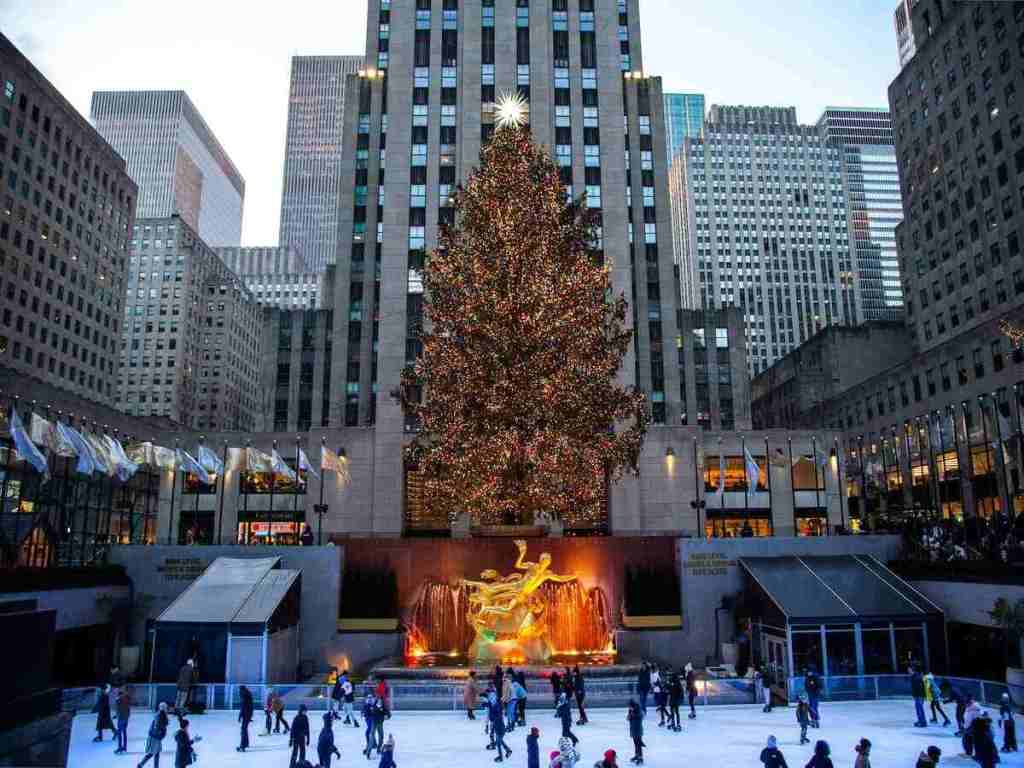
The Rockefeller Center tree is located at Rockefeller Center, west of Fifth Avenue from 47th through 51st Streets in New York City.
The Rockefeller Center Christmas Tree dates back to the Depression era, with the first tree placed in 1931. It was a small unadorned tree set up by construction workers at the center of the construction site. Two years later, another tree was placed there, this time with lights.
These days, the giant Rockefeller Center tree is laden with over 50,000 Christmas lights. The tallest tree displayed at Rockefeller Center arrived in 1999. It was a Norway Spruce that measured 100 feet tall and hailed from Killingworth, Connecticut.
The wider history of Christmas trees

Long before the advent of Christianity, plants and trees that remained green all year had a special meaning for people in the winter. Just as people today decorate their homes during the festive season with pine, spruce, and fir trees, many ancient peoples hung evergreen boughs over their doors and windows. In many countries, it was believed that evergreens would keep away witches, ghosts, evil spirits, and illness.
In the Northern Hemisphere, the shortest day and longest night of the year falls on December 21 or December 22 and is called the winter solstice. Many ancient people believed that the sun was a god and that winter came every year because the sun god had become sick and weak. They celebrated the solstice because it meant that at last, the sun god would begin to get well. Evergreen boughs reminded them of all the green plants that would grow again when the sun god was strong and summer would return.
The ancient Egyptians worshipped a god called Ra, who had the head of a hawk and wore the sun as a blazing disk in his crown. At the solstice, when Ra began to recover from his illness, the Egyptians filled their homes with green palms and papyrus reeds, which symbolized for them the triumph of life over death.
Early Romans marked the solstice with a feast called Saturnalia in honor of Saturn, the god of agriculture. The Romans knew that the solstice meant that soon, farms and orchards would be green and fruitful. To mark the occasion, they decorated their homes and temples with evergreen boughs.
In Northern Europe, the Druids, the priests of the ancient Celts, also decorated their temples with evergreen boughs as a symbol of everlasting life. The Vikings in Scandinavia honored the evergreen mistletoe for its role in the death of the Balder, a god of light.
The use of evergreen trees, wreaths, and garlands to symbolize eternal life was a custom of the ancient Egyptians, Chinese, and Hebrews. Tree worship was common among the pagan Europeans and survived their conversion to Christianity in the Scandinavian customs of decorating the house and barn with evergreens at the New Year to scare away the Devil and of setting up a tree for the birds during Christmastime.
Is Christmas tree a religious symbol?

The most popular symbol of Christmas, except perhaps for Santa Claus, may also be the least Christian: the Christmas Tree. Originally derived from pagan religious celebrations in Europe, the Christmas Tree was adopted by Christianity but never entirely at home in it. Today the Christmas Tree can be a completely secular symbol of Christmas celebrations. Curiously, Christians latch on to it as if it were inherently Christian.
There is at least as much in the way of secular Christmas tree decorations as there are Christian decorations. The lighting itself, perhaps the most obvious part of Christmas tree decoration, isn’t the least bit Christian. All the balls, garlands, and so forth also lack any Christian basis. A Christmas tree with secular decorations can be treated as a secular symbol of a secularized holiday. In fact, it can be argued that Christmas trees are unchristian.
Christmas trees have become popular for purely cultural reasons. There’s nothing inherently Christian about them: Christians can give them up without sacrificing anything religious while non-Christians can use them without necessarily giving in to pressure to conform to Christian practices. If Christians could adopt the use of Christmas trees without any biblical or traditional warrant, but instead on the apparent basis of ancient pagan custom, then non-Christians can also adopt them and strip them of Christian connotations.
Christians have celebrated Christmas in one form or another for centuries, but Christmas as people in modern America know it is a relatively recent development — it’s made up of various elements, mostly secular, that coalesced during the 19th and early 20th centuries. Because those elements are recent and fairly secular, it’s not much of a stretch to suggest that they can be disentangled from Christianity and used as the basis for a secular holiday during the Christmas season.
The commercial side of Christmas trees
Christmas today is a big business, and one part of that is the multibillion-dollar business of selling Christmas trees. The U.S. Christmas tree industry is so large, that it even has two dueling trade groups: one that supports natural trees and the other, artificial.
There are three different ways to get a natural Christmas tree.
First, you can go into a national forest and chop down your own. Relatively few Americans do this, even though a permit costs $10 or less, because government rules require that the tree you chop must be more than 200 feet from any road, campground, or recreation area. Since dragging a tree destroys its branches and needles, the 200-foot rule means that large, heavy trees have to be carried a fair distance through often snowy woods.
Your second option is to buy or chop down a tree at a local Christmas tree farm. There are nearly 3,000 Christmas tree farms across the U.S., according to the Department of Agriculture’s most recent figures. These farms sell around 12 million trees a year. While being a Christmas tree farmer sounds idyllic, it isn’t very profitable, since Christmas trees take over a decade to grow large enough to sell. Long lead times combined with changing and unpredictable weather have pushed many of these farms out of business. Almost 500 U.S. Christmas tree farms shuttered between 2014 and 2019, the USDA found.
The third way to buy a tree is from a local retailer that imports trees. In 2022, the U.S. imported almost 3 million natural Christmas trees, primarily from Canada. Imports have been growing steadily: In 2014, the U.S. imported only half as many trees.
Which type of Christmas tree people will choose will depend on various reasons. Sometimes people buy artificial ones because it’s reusable and more environmentally friendly. Also, it’s good for people who suffer from allergies and don’t want to end up cleaning after it. And it’s easy to put it away and store it for the next year. People who buy real Christmas trees will sadly have to discard them next January but they are more traditional and enjoy the smell of forest in their own homes. It will also depend on the budget they are willing to sacrifice for this tradition. Large Christmas trees are of course more expensive and Americans are known for wanting to have tall trees in their homes. Maybe the most important part is that you choose a Christmas tree to celebrate with your family. Whether you are a religious person or not there are a lot of things we can celebrate with our closest one. And Christmas trees help us to bring more joy and light into our lives.
 Things we do for health